Water Chemistry

Cyanuric acid: the number your Arizona pool lives by.

CYA decides whether your chlorine survives the Arizona sun or burns off by lunch. It is also the reading most pools in the Valley get wrong. Here is what it does, where it should sit, and how to bring it down when it climbs.
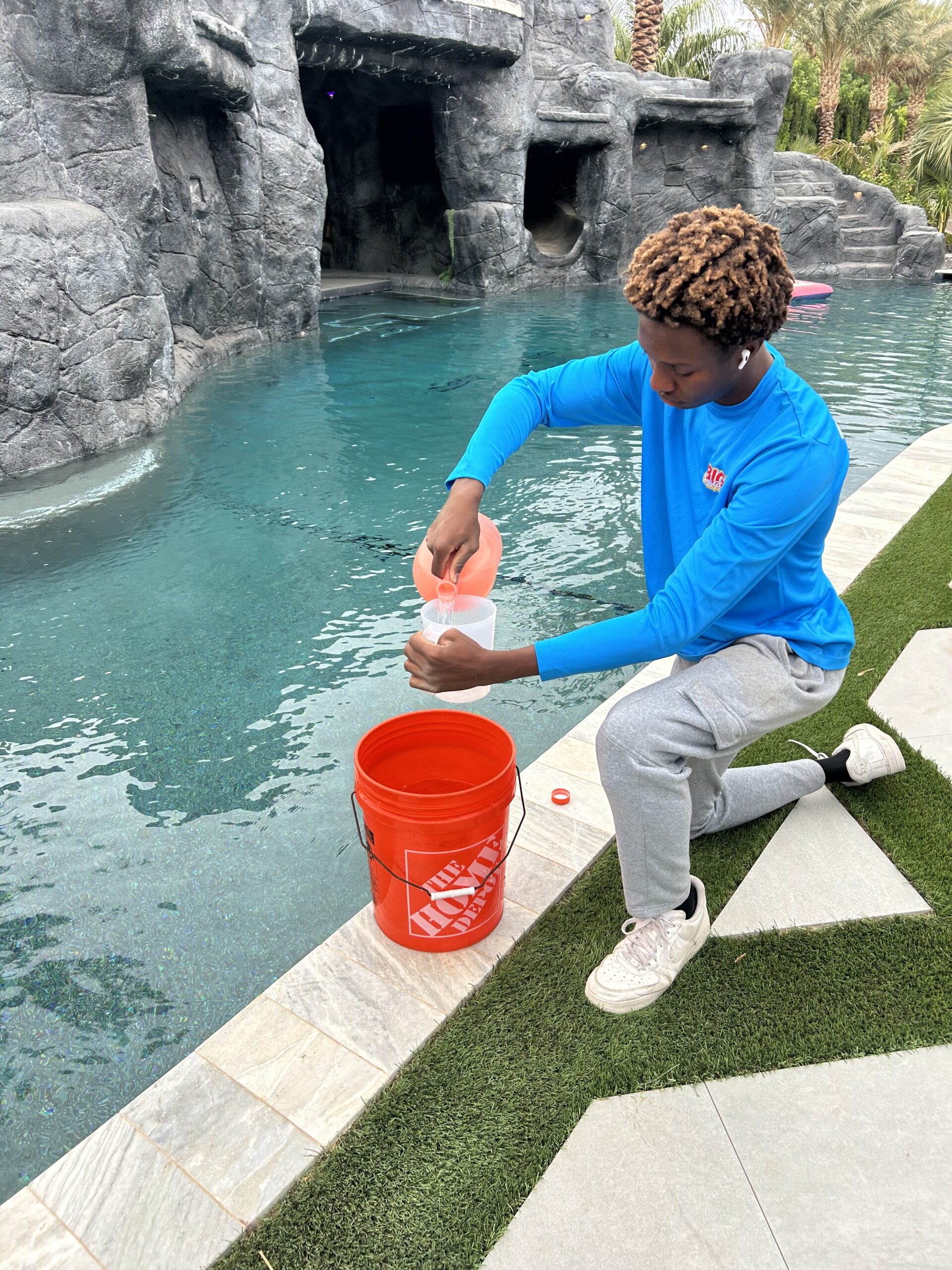
Water chemistry testing during a routine BIG Family Pools service visit
What It Is

Sunscreen for your chlorine.

Cyanuric acid, called CYA, stabilizer, or conditioner, is a compound that shields chlorine from ultraviolet light. Unprotected chlorine breaks down fast in direct sun. In a Phoenix summer, a pool with no CYA can lose most of its free chlorine in a few hours, leaving the water unprotected for the rest of the day.

With CYA in the proper range, chlorine persists through the day and does its job: sanitizing the water, oxidizing contaminants, and keeping algae from ever getting started. That makes CYA one of the most important readings in Arizona pool care, and one of the most misunderstood.

The Right Level

Where CYA should sit.

The target depends on how your pool is sanitized. More is not better. Past the proper range, every additional ppm of CYA makes your chlorine work slower.

  • Standard chlorine pool: 30 to 50 ppm. Enough UV protection to carry chlorine through an Arizona afternoon without blunting its killing power.
  • Saltwater pool: 60 to 80 ppm. Salt systems generate chlorine gradually all day, so the water needs more sustained UV protection. Most salt cell manufacturers specify this range.
  • Above roughly 100 ppm: correction territory. Chlorine efficacy drops steeply. The water can show a normal free chlorine reading while sanitizing poorly. This is how pools turn green with "good" chlorine numbers.
Why It Climbs

Tablets put it in. Evaporation concentrates it. Nothing takes it out.

Stabilized chlorine tablets, the trichlor pucks sold in every bucket at the big box store, are roughly half cyanuric acid by weight. Every tablet raises CYA a little. The chlorine gets used up. The CYA does not. It does not evaporate, it is not consumed by sunlight, and the filter does not remove it.

Arizona then compounds the problem. A Valley pool can evaporate its entire volume over the course of a year. The water leaves, the CYA stays, and the concentration ratchets upward with every refill. A pool run on tablets here can pass 150 ppm within a couple of seasons.

This is why BIG Family Pools does not run client pools on a tablet-only diet. Chlorine dosing that adds no stabilizer, checked against a documented weekly log, keeps CYA inside its range instead of on a one-way climb.

Bringing It Down

The only reliable fix is a water exchange.

Chemical CYA reducers exist. In our experience they are slow, inconsistent, and expensive relative to the result. Removing water removes CYA. Everything else is a workaround.

  • The math is proportional. Replace a third of the water, lose a third of the CYA. Getting from 150 ppm down to 50 ppm means exchanging roughly two thirds of the pool.
  • Do not fully drain a plaster pool in summer. Exposed plaster in 110 degree heat can crack and delaminate, and an empty shell can shift with ground moisture. In the hot months, partial exchanges or reverse osmosis are the safer path. Full drains belong to the cooler season.
  • Follow your city's discharge rules. East Valley cities require pool water to go to your sewer cleanout, not the street. Salt pools especially.
  • Reverse osmosis is the water-wise option. Mobile RO filtration strips CYA, calcium, and dissolved solids while keeping most of the water in the pool. It costs more than a drain but avoids the heat risk and the refill.
The BFP Standard

We manage CYA before it becomes a project.

Every BIG Family Pools client pool gets its chemistry tested and logged weekly, CYA included, as part of our aquatic asset management program. We balance to the Langelier Saturation Index, not to a test strip, so CYA is managed in context with calcium, alkalinity, pH, and temperature rather than chased as a lone number.

The result is a pool that never needs an emergency drain, because the trend was visible in the log months before it became a problem. Preventive maintenance over reactive repair. That is the whole model.

If nobody has told you your CYA number lately, nobody is watching it.

Get Started

Find out where your water actually stands.

Every new client relationship starts with a property evaluation, including a full chemistry panel with CYA, calcium hardness, and LSI balance. We assess the water, the equipment, and the property before any service begins.

Request an Evaluation